
July 31, 2026
A vehicle wrap is a printed or coloured adhesive film applied over factory paint to change a vehicle's look or carry a message. This guide explains what a wrap is, how it works, what it costs, how long it lasts and why businesses use it as mobile media.
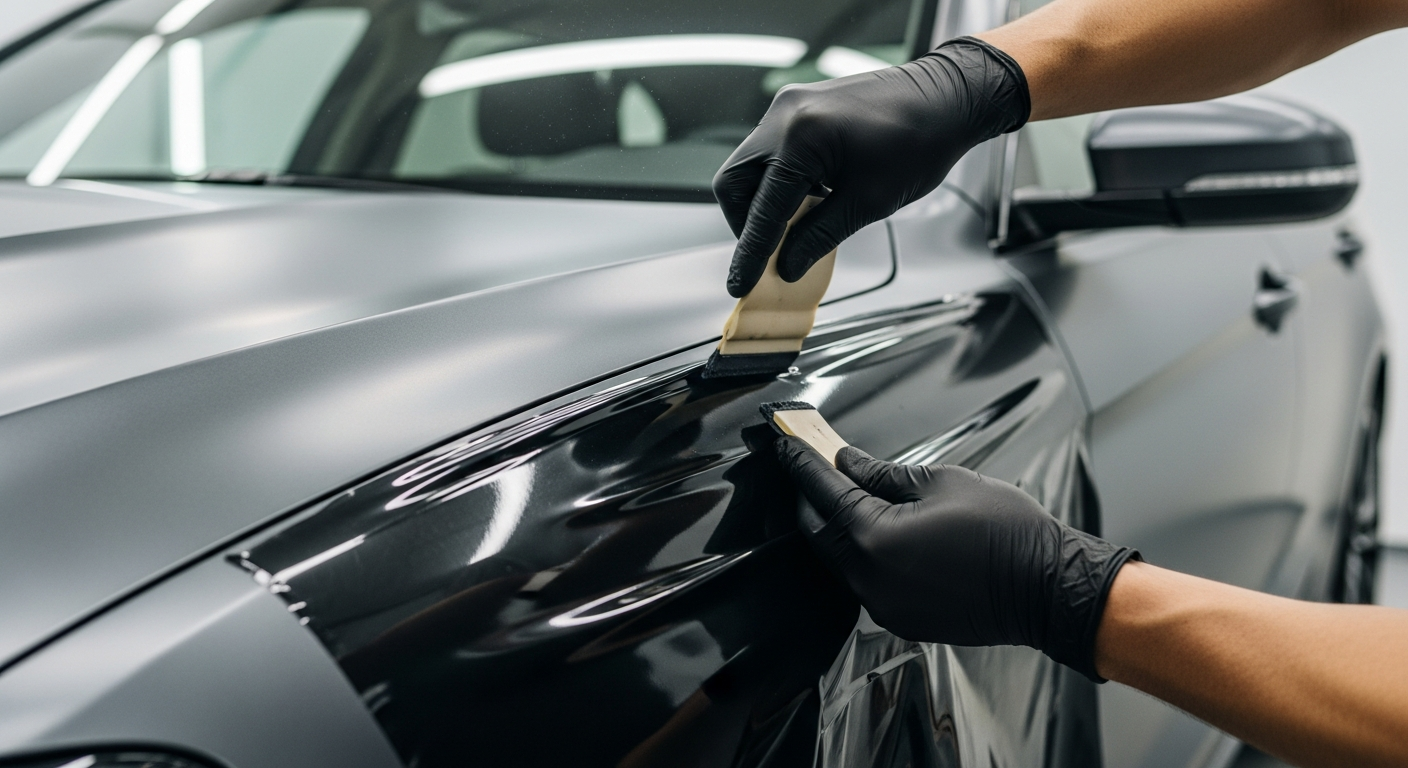
A vehicle wrap is a printed or coloured adhesive film, applied over a vehicle's factory paint to change its appearance or to carry a visual message. The technique sits at the meeting point of two worlds: vehicle customisation on one side, and out-of-home advertising on the other. For a company, a wrap turns a working asset that already travels every day into a mobile surface for its brand.
The market behind this technique has grown quickly. The global automotive wrap films market was estimated at around 3.5 billion US dollars in 2024, with double-digit annual growth forecast over the following years, according to market analysis published by Grand View Research. Demand is driven by both personalisation and the protective qualities of modern films.
This guide explains what a vehicle wrap is, the materials and finishes available, how the fitting process works, how long a wrap lasts, what determines its cost, where it earns its keep for a business, and the main legal points to check in the United Kingdom before a vehicle goes back on the road.
The word wrap is often used loosely, so it helps to separate it from neighbouring techniques. A full wrap covers most or all of the visible bodywork with vinyl film. A respray, by contrast, changes the paint itself, which is permanent and harder to reverse. The two answer different needs: one is removable and protective, the other is a lasting change to the vehicle.
Decals and lettering form a third category. Here, only parts of the bodywork carry adhesive graphics, such as a company name, a logo or a phone number, rather than a full-surface film. This partial approach, sometimes described as vehicle lettering, is the lightest and least expensive option. A studio that handles vehicle lettering and decals can advise on the balance between coverage and budget.
Paint protection film is a fourth, related product. It is usually a clear or lightly tinted film whose main job is to shield the paint from stone chips and abrasion rather than to change colour or carry a design. A wrap can deliver some of that protection as a side benefit, but its primary purpose is visual.
Wraps are commonly grouped by how much of the vehicle they cover and by the visual effect of the film.
A full wrap covers the entire visible surface and is the choice for a complete colour change or a full advertising livery. A partial wrap covers selected panels, such as the doors, bonnet or roof, and is used when a business wants a clear message without the cost of full coverage. Spot graphics and lettering cover the smallest area and suit a simple, contact-details livery on a working van.
The same colour can be supplied in several finishes, each with its own look and maintenance profile:
Colour-change wraps deserve a separate mention. A film that changes the dominant colour of the vehicle has legal implications in several countries, including a notification requirement in the United Kingdom, covered later in this guide.
Almost all vehicle wraps are made from polyvinyl chloride, a plastic made flexible through additives, a development that traces back to the late 1920s and was later adapted for sign-making and, by the 1990s, for digitally printed vehicle graphics, as set out in the overview of the history of wrap advertising. Two manufacturing methods produce two families of film with different properties.
Cast vinyl is produced by spreading a liquid mix onto a casting sheet and curing it, which yields a thin film, typically in the region of 50 microns, that conforms to curves, recesses and rivets with very little tendency to shrink back. Calendered vinyl is produced by rolling and stretching the material, which makes it thicker and gives it a memory that pulls it back towards its original shape, so it suits flat or gently curved surfaces better than complex ones.
The practical consequences matter for a buyer. Cast film generally carries a longer outdoor rating, in the order of five to seven years or more, and is the usual choice for a full wrap that has to sit over door handles, mirrors and body lines. Calendered film costs less and works well for flat-panel graphics and shorter campaigns, but it is more prone to edge lifting and shrinkage over time on demanding shapes.
A durable result depends as much on preparation and method as on the film itself. A professional fit follows a consistent sequence.
Some panels, such as deep bumpers and mirror caps, are removed during fitting so that the film can be wrapped cleanly behind the edges. This is one reason a quality wrap is a workshop job rather than a quick task, and why fitter skill has a direct effect on how long the result lasts.
The working life of a wrap depends on the film grade, the quality of the fit, and the conditions the vehicle meets. A cast film fitted to a daily-use vehicle commonly lasts five to seven years, while a calendered film is closer to two to four years. Three factors do most of the work in stretching or shortening that range: sun exposure, washing habits and where the vehicle is parked.
Care is straightforward but specific. Hand washing is preferred over abrasive brushes, automated rollers can catch edges, and matte finishes in particular should not be polished or waxed in the way painted gloss is treated. A vehicle kept under cover overnight will generally outlast an identical wrap left in full sun. Removing a film towards the end of its rated life, rather than long after, keeps removal clean and protects the paint beneath.
Wrap pricing is best expressed as a range rather than a single figure, because several variables move the total. The body itself is the first: a compact car presents far less surface than a long-wheelbase van, and a van with high sides carries more square metres of film. Coverage is the second: a full wrap costs more than a partial wrap, which costs more than lettering alone.
Three further factors complete the picture. The film grade and finish change the material cost, as cast and specialty finishes sit above standard calendered film. Design and printing add cost when a bespoke livery is involved, as opposed to a plain colour change. Finally, preparation work, such as removing an older wrap or correcting paint, adds labour. For a business comparing options across several vehicles, an online configurator helps turn these variables into a structured quotation rather than a rough estimate.
For a company, the strongest case for a wrap is advertising reach at a low cost per view. A vehicle that already drives a daily route becomes a moving billboard with no media-buying fee for the road space. Surveys of the sector point to high public visibility: an out-of-home advertising study reported that a clear majority of respondents had noticed a wrapped vehicle in the previous month, as set out in the Morning Consult study published by the OAAA.
Recall is the second argument. Out-of-home formats, the category that includes vehicle graphics, tend to score highly on consumer recall against other channels, according to benchmark findings reported by the OAAA. A consistent livery across a fleet compounds that effect, since each vehicle reinforces the same identity in the same area.
The scale of the opportunity is visible in the fleet itself. There were around 31.1 million vans on the road in the European Union, with France, Italy and Spain together accounting for roughly half of them, according to the ACEA report on vehicles on European roads. New registrations have remained dynamic, with EU van sales rising in 2024 on the figures from ACEA commercial vehicle registration data. Every one of those vehicles is a potential surface for a brand. A structured fleet programme often draws on a wider range of vehicle branding services rather than a single one-off wrap.
A wrap is a modification, and a few rules apply once the vehicle returns to public roads. The first concerns colour. When a wrap changes the main colour of a vehicle, the registered keeper must tell the licensing authority, as explained in the GOV.UK guidance on changing vehicle details on the V5C registration certificate. A change covering more than about half of the bodywork is generally treated as a colour change, and there is no fee to record it.
The second point concerns visibility. A wrap must not obscure the registration plates or extend over glazed areas in a way that breaks the rules. Number plates have to remain legible and unobstructed under the GOV.UK rules on displaying number plates, a requirement set out in detail in the Road Vehicles (Display of Registration Marks) Regulations 2001. Film over windows is also constrained: the windscreen must let through at least 75 per cent of light and the front side windows at least 70 per cent, under the GOV.UK rules on tinted vehicle windows.
A third point is commercial rather than regulatory. For a business, the cost of advertising and signage on vehicles is generally treated as an allowable business expense, provided it is incurred wholly and exclusively for the trade, as indicated in the GOV.UK guidance on marketing and advertising expenses for the self-employed. A company should confirm its own position with its accountant before relying on this.
The subject of this guide connects with several services offered by Brands And Markets. A business weighing a full colour-change wrap against a lighter option can compare the approach with vehicle lettering and decals, which suits a simple, contact-led livery on a working vehicle.
For a manufacturer or a structured fleet project, the question often moves from a single vehicle to a coordinated programme. The range animation service addresses special editions and coordinated launches, while customised vehicle accessories can extend a livery beyond the bodywork itself.
A vehicle wrap is a removable adhesive film that changes how a vehicle looks and lets it carry a message, while protecting the paint underneath when it is fitted and removed within its rated life. The choice between cast and calendered vinyl, full and partial coverage, and gloss or matte finish should follow the use, the budget and the shape of the vehicle rather than a single rule of thumb.
For a company, the appeal is a durable, low cost-per-view advertising surface that travels where the business already goes, set against a small number of legal steps to clear before the vehicle returns to the road. A practical next step is to scope the work vehicle by vehicle, which an online configurator makes faster for a fleet of more than a handful of units.
The lifespan depends on the film grade, the quality of the fit and the conditions the vehicle meets. A professionally fitted cast vinyl wrap lasts on average five to seven years in daily outdoor use. A thinner calendered film usually lasts two to four years before edges begin to lift or the colour dulls. Three factors stretch or shorten that range: exposure to sunlight, washing habits and where the vehicle is parked. A vehicle kept under cover overnight typically outlasts an identical wrap left in full sun. Removing the film towards the end of its rated life, rather than long after, keeps the process clean and protects the paint underneath.
A wrap applied over sound, intact factory paint does not damage it and in fact shields the surface from minor abrasion and ultraviolet exposure during its life. When the film is removed within its recommended lifespan by a trained fitter, it lifts away cleanly and leaves the original paint intact. This reversibility is one reason wraps are common on leased and fleet vehicles, where the original finish must be preserved for return or resale. The main risk arises when film is left on well beyond its rated life, as ageing vinyl becomes brittle and slower to remove. Wrapping over paint that is already chipped, flaking or freshly applied is not advised.
In the United Kingdom, the registered keeper must notify the licensing authority when the main colour of a vehicle changes. In practice this applies when a wrap covers more than roughly half of the bodywork, which is treated as a colour change. The new colour is recorded on the V5C registration certificate, and there is no fee for the update. Partial graphics, stripes or lettering that do not change the dominant colour do not usually require notification. Failing to record a genuine colour change can complicate insurance and resale, so a keeper in any doubt should record the dominant new colour and keep the documentation with the vehicle file.
Industry surveys place a single wrapped vehicle in the range of tens of thousands of visual impressions per day, with the exact figure driven by mileage, route and traffic density. A vehicle covering busy urban routes is seen by far more people than one parked most of the day. Beyond raw impressions, out-of-home advertising studies report high public awareness of wrapped vehicles and strong recall for the format relative to static media. For a business, the practical measure is cost per thousand views over the life of the wrap, which tends to compare favourably with fixed media because a single fitting cost is spread across several years of daily exposure.
Yes. A wrap is designed to be reversible, which is a core part of its appeal. A trained fitter warms the film to soften the adhesive, peels it away panel by panel, then removes any residue with appropriate products. On sound paint, the surface underneath is revealed clean and unchanged. Removal is cleanest when the film has not been left on well beyond its rated lifespan, because ageing vinyl grows brittle, can tear and lifts more slowly, which adds labour. For this reason a planned removal at the end of the rated life is easier and less costly than an emergency removal of a film that has been neglected for years.
Prêt à transformer votre projet ? Discutons de vos besoins et de la manière dont nous pouvons collaborer.
Adresse : 28 rue Fresnel – F-78310 COIGNIERES
Téléphone : 01 85 40 01 75