June 16, 2026
Every vinyl vehicle wrap starts with the film family. This guide compares cast and calendered vinyl on thickness, conformability, finish, lifespan and price per square metre, so a business can match the right material to each panel and budget.
Every vinyl vehicle wrap starts with a choice that decides how the finished panel looks, how long it survives outdoors and how much it costs: the film family. Two families dominate the market, cast and calendered, and the gap between them is wider than the price tag suggests. A premium cast film carries an outdoor durability rating of five to seven years, while a calendered film often sits at one to three years for the same vertical surface, a difference driven mainly by additive chemistry rather than thickness.
The distinction matters to any business comparing quotes. A delivery operator covering a flat van flank has different needs from a studio dressing a deeply contoured bonnet, and the right film keeps the budget honest in both cases. The wider market reflects that demand: the global automotive wrap films sector was valued in the billions and is forecast to grow at a strong double-digit rate over the coming years, according to published market analysis on automotive wrap films.
This guide breaks down what a vinyl vehicle wrap is made of, how cast and calendered films differ across thickness, conformability and lifespan, which finishes are available, what the price per square metre depends on, and the legal and environmental points a fleet should check before committing.
A vinyl vehicle wrap is a self-adhesive film built in three working layers: a face film of plasticised polyvinyl chloride that carries the colour or print, a pressure-sensitive adhesive on the reverse, and a release liner that is peeled away during fitting. The face film is the part that determines flexibility and outdoor life, since it holds the pigment and the ultraviolet stabilisers.
The base polymer, polyvinyl chloride, is a thermoplastic whose properties are tuned by additives such as plasticisers, heat stabilisers and pigments, as described in the reference material on polyvinyl chloride and its additives. The adhesive layer usually relies on pressure-sensitive adhesive technology, often with air-release channels moulded into it so trapped air can escape during application. The way that face film is manufactured, cast or calendered, defines almost everything that follows.
The names refer to two completely different manufacturing routes. The route, not the brand, sets the performance envelope of any vinyl vehicle wrap.
Cast film is made by mixing liquid polyvinyl chloride with plasticisers, stabilisers and pigment, pouring that liquid onto a moving casting sheet, then heating it so the solvents evaporate and a solid film is left behind. Because the film is formed without being stretched, it carries almost no internal stress, so it stays dimensionally stable once fitted and resists the shrink-back that pulls film away from recessed edges.
That stability is why cast film conforms to compound curves, channels and rivets, and why it holds position after the heat of installation is removed. Premium cast products are typically 50 to 100 microns thick, thinner than most calendered film, yet they carry the longer outdoor rating because the casting formulation packs in the ultraviolet stabiliser chemistry that protects the pigment.
Calendered film is produced by feeding a solid polyvinyl chloride compound through a series of heated precision rollers that progressively squeeze it into a thin sheet, a high-volume process documented by the British Plastics Federation description of calendering. The rolling action stretches the polymer, which leaves internal stress in the film, so calendered material tends to spring back partially when heated and cooled on a curved panel.
Calendered film usually measures 80 to 150 microns and costs noticeably less to make, which makes it a sensible choice for flat or gently curved surfaces, short campaigns and large simple panels. Its weakness is conformability and outdoor life: most calendered products are rated one to three years outdoors, and they show more thickness variation across the roll than cast film.
Four properties separate the two families in practice. Reading them together explains why a quote for a vinyl vehicle wrap can vary so much for what looks like the same job.
The durability gap is the point most often misunderstood. It is not the extra thickness of calendered film that makes a wrap last, since cast film is actually thinner. The deciding factor is the ultraviolet stabiliser content engineered into the cast face film, which slows pigment breakdown under sunlight.
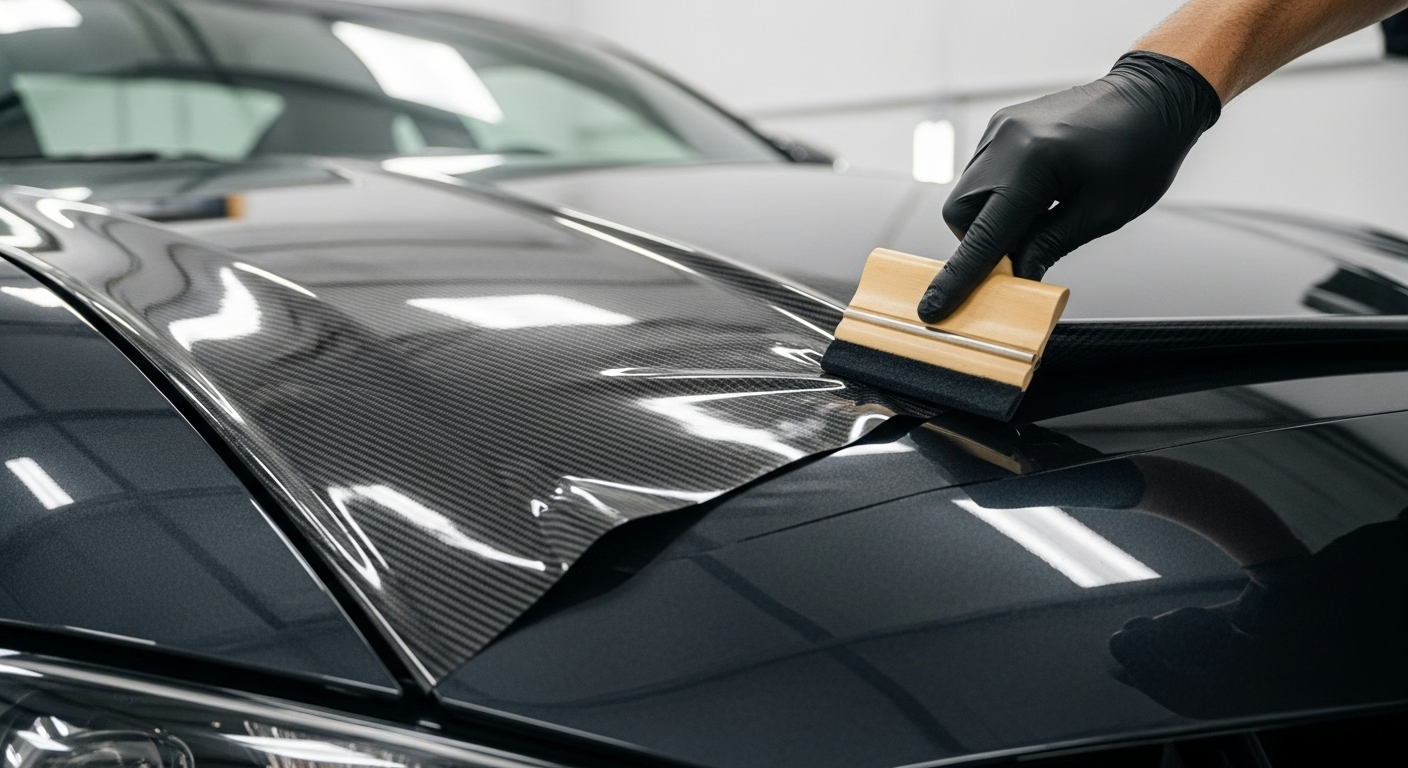
Beyond the cast and calendered split, a vinyl vehicle wrap is specified by its finish, which is the visible surface effect. The common families are gloss, satin, matte, metallic, chrome, colour-shift and textured effects such as a woven carbon-look pattern. A gloss surface reflects light and reads as a painted look, but it shows fingerprints and minor marks more readily. A matte or satin surface scatters light, which hides swirl marks and small scratches but is harder to clean if it picks up grease.
Many premium colour films carry a built-in protective top layer or are paired with a separate laminate that adds scratch resistance and ultraviolet protection. Specialty effects such as chrome and deep colour-shift films are usually more demanding to fit and more sensitive to stretching, so they tend to be reserved for cast products and experienced fitters. The choice of finish is a brand and design decision as much as a technical one, which is where structured range animation for vehicle line-ups helps keep a fleet coherent.
Film cost per square metre is only one part of a wrap budget, but it is the part that the cast and calendered split influences most. Calendered film sits at the lower end per square metre, which is why it dominates short promotional campaigns and simple panel graphics. Cast film costs several times more per square metre, a premium justified on contoured vehicles by its longer life and cleaner result.
The installed price of a vinyl vehicle wrap also reflects labour, the complexity of the panels, whether a laminate is added, and any design or print work. A deeply contoured car takes far more fitting time than a flat-sided van of the same surface area, so two jobs with identical square-metre figures can be priced very differently. For a fleet, repeated panels and a single approved design lower the effective cost per vehicle, and an online quote through the vehicle configurator gives a quick cost frame before any panel is touched.
Outdoor durability ratings assume a vertical surface, professional fitting and reasonable care. Horizontal panels such as a roof or bonnet receive more direct sunlight and rain, so they age faster than flanks, and a real-world wrap often shows its first wear there. Garaging the vehicle and washing it gently by hand rather than through abrasive automated systems both extend the working life of the film.
Removal is part of the material calculation. A cast film fitted over good original paint is designed to be heated and peeled away cleanly, leaving the factory surface intact, which is one reason a wrap is often chosen over a respray. A calendered film left too long outdoors can become brittle and tear during removal, which raises the labour cost of taking it off. Planning a removal before the rated life expires keeps that risk low.
A vinyl vehicle wrap that changes the main colour of a vehicle carries administrative duties. In the United Kingdom a change of the recorded colour has to be updated on the registration certificate, as set out in the official guidance on how to change vehicle details on a V5C registration certificate. Partial graphics or lettering that do not change the main colour do not need that update.
Two further rules constrain where film can be applied. Number plates have to remain legible and standard, a requirement detailed in the guidance on displaying number plates and underpinned by the Road Vehicles (Display of Registration Marks) Regulations 2001. Film must not reduce the transparency of windscreens and front side windows below the legal limits described in the tinted vehicle window rules. A professional fitter keeps glass, lights and plates clear of any film that would breach those limits.
Because the face film is polyvinyl chloride, end-of-life handling is part of a responsible specification. The European Chemicals Agency has reviewed the additives used in polyvinyl chloride and recommended measures to limit certain plasticisers and to improve the technologies that reduce microparticle release at recycling and disposal sites, as set out in its findings that identify risks from PVC additives and microparticle releases. A buyer specifying a large fleet programme can ask a supplier how removed film is collected and routed for disposal.
The scale of the vehicle parc gives the question weight. European registration and fleet data published by the European Automobile Manufacturers Association report on vehicles on European roads show a parc of hundreds of millions of vehicles, so even a small share moving to wraps represents a meaningful volume of film over its life cycle.
The material choices in this article connect with several services offered by Brands And Markets. A reader who wants the wider picture of what a wrap is and how it is fitted can start with the companion article on what a vehicle wrap is for a business, which sets the context this materials guide builds on.
For projects that mix full colour change with lettering or partial graphics, the page on vehicle lettering and decals details the options, while bolt-on items are covered under customised vehicle accessories. A structured fleet brief is easiest to scope through the full services overview.
The film family is the first and most consequential decision behind any vinyl vehicle wrap: cast film for contoured panels and a five to seven year life, calendered film for flat surfaces, short campaigns and a tighter budget. Thickness, conformability, finish and price all flow from that single split, and the durability gap rests on additive chemistry rather than on how thick the film feels.
A buyer who matches the film to the panel shape, the planned display time and the disposal route avoids both overspending on a flat van and underspecifying on a contoured car. Comparing a film-only price against a full installed quote, and confirming the legal and environmental points early, turns a wrap from a guess into a controlled specification. A scoped estimate through the online configurator gives a fleet a clear starting figure.
Cast film is poured as a liquid and cured into a thin, stable layer of roughly 50 to 100 microns that conforms to curves and resists shrink-back. Calendered film is rolled and pressed from solid material into a thicker sheet of around 80 to 150 microns, costs less and suits flat or gently curved panels. The longer outdoor rating of cast film comes from the ultraviolet stabiliser chemistry built into its formulation, not from its thickness, since cast film is actually the thinner of the two. The right choice depends on panel shape, display time and budget.
A professionally fitted cast film commonly lasts five to seven years in daily outdoor use, while a calendered film usually lasts one to three years before colour fade or edge lifting appears. Horizontal panels such as the roof and bonnet age faster because they take more direct sunlight and rain. Garaging the vehicle, limiting ultraviolet exposure and washing the film gently by hand all extend its working life. A planned removal before the rated life expires protects the original paint underneath and keeps the labour cost of taking the film off low.
Material cost depends on the film family. Calendered film sits at the lower end per square metre, which suits short campaigns and simple panels, while premium cast film costs several times more. Installed pricing then adds labour, panel complexity, any laminate and design work, so two jobs with the same surface area can be priced very differently. A deeply contoured car takes far more fitting time than a flat van flank. For a fleet, a single approved design across repeated panels lowers the effective cost per vehicle, which is why a per-vehicle quote is more useful than a film-only rate.
In the United Kingdom a change of the main vehicle colour, whether by paint or by a full wrap, has to be recorded on the V5C registration certificate and returned to the licensing authority. Partial graphics, stripes or lettering that leave the main colour unchanged do not require an update. Keeping the record current matters for insurance and for roadside checks, where the documented colour should match the vehicle on the road. The update carries no fee, and a replacement certificate is normally returned within a few weeks.
Prêt à transformer votre projet ? Discutons de vos besoins et de la manière dont nous pouvons collaborer.
Adresse : 28 rue Fresnel – F-78310 COIGNIERES
Téléphone : 01 85 40 01 75