July 31, 2026
Commercial vehicle wraps turn vans, lorries and courier fleets into mobile advertising. This guide sets out typical UK pricing per coverage level, material choices, the DVLA, insurance and VAT rules, and the practical steps for rolling a livery out across a working fleet.

A commercial vehicle spends its working life in places an advertising budget struggles to reach: motorway traffic, customer car parks, residential streets during deliveries. A wrap converts that bodywork into advertising space the business already owns, a practice documented as wrap advertising since the 1990s. Unlike paid media, the exposure continues for the life of the film with no recurring fee.
The scale of the opportunity is visible in the registration data. The light commercial vehicle figures published by the SMMT show vans as one of the most active segments of the UK market, and most of those vehicles leave the factory in plain white. Every unbranded panel is an unused asset.
Four questions decide most commercial wrap projects: what the options actually are, what they cost per vehicle, which road and tax rules apply, and how to roll a livery out across a working fleet without disrupting operations. Each is covered below with the figures and official references a decision maker needs.
The term commercial vehicle wrap covers several distinct products, and the price gap between them is wide. Understanding the vocabulary avoids comparing quotes that describe different things. A general overview of the technique is available in this guide to what a vehicle wrap is.
For a fleet operator, the choice is rarely aesthetic alone. It sets the budget per unit, the fitting time per vehicle and the regulatory follow-up, since a change of dominant colour triggers a registration update while simple lettering does not.
The workhorse of commercial wrapping is the panel van. The light commercial vehicle category, up to 3.5 tonnes, offers large flat side panels that suit printed graphics and keep fitting labour reasonable. Above that weight, box lorries and trailers provide even larger surfaces: a curtainsider or box body operates in practice as a rolling billboard on trunk routes.
Courier and last-mile fleets are a case of their own. Their vehicles cover high daily mileage in dense urban areas, which maximises exposure, but the same duty cycle accelerates wear on the film. Material choice and washing routine matter more for these fleet vehicles than for a tradesperson's van parked at home overnight.
Fleet age also shapes the decision. According to the ACEA report on vehicles in use, light commercial vehicles on European roads are around twelve years old on average. A wrap applied mid-life refreshes the appearance of an ageing van at a fraction of the cost of replacement, and the film protects the paint underneath from stone chips and minor abrasion until the vehicle is sold.
Two film families dominate the market. Cast film is produced by pouring liquid PVC onto a casting sheet, which leaves the material dimensionally stable and able to stretch into recesses and over rivets without lifting. Calendered film is rolled between heated cylinders, a process described by the British Plastics Federation, which makes it thicker, cheaper and best suited to flat panels.
On a commercial vehicle the split is practical rather than theoretical. Large flat van sides accept calendered film for short campaigns of one to three years, while cast film with a protective laminate is the standard choice for a livery expected to last five to seven years. A detailed comparison of the two constructions is available in this guide to vinyl wrap materials.
Duty cycle drives longevity as much as the film itself. Daily motorway mileage, automatic brush washes and unsheltered parking all shorten service life, points developed in this analysis of how long a vehicle wrap lasts. Fleets that specify hand washing and plan a removal date before the adhesive ages protect both the film and the resale value of the vehicle.
Fitted prices observed on the UK market follow the coverage levels described above. Cut lettering starts from a few hundred pounds per vehicle. A partial wrap on a medium van commonly sits between 800 and 1,500 pounds. A full wrap on a panel van typically runs from 2,000 to 3,500 pounds depending on wheelbase and roof height, and a printed livery on a large lorry or box body can reach 3,000 to 6,000 pounds. The mechanics behind these figures, from surface area to labour rates, are detailed in this breakdown of vehicle wrap cost.
Fleet economics improve with volume. When the same artwork is repeated across ten or twenty identical vans, design, colour profiling and print setup are paid once and spread over the run, which commonly reduces the unit price by five to ten per cent. Scheduling also matters: an installer who receives vehicles in a steady sequence quotes tighter than one asked to mobilise for a single urgent job. Van-specific pricing and rollout patterns are covered in this guide to van vehicle wraps.
The return side of the calculation rests on a simple property: the wrap is a one-off cost that keeps working. Once fitted, a livery generates exposure on every journey the vehicle was already making, with no monthly media fee. Against the recurring cost of local advertising space, a film amortised over five years of daily circulation is one of the lowest cost-per-view formats available to a local business, even before counting the paint protection it provides.
Wrapping a commercial vehicle is legal and common, but three administrative points apply. First, if the wrap changes the dominant colour of the vehicle, the change must be recorded on the V5C registration certificate, following the procedure described on the official DVLA page for changing vehicle details. Lettering and partial graphics that leave the base colour unchanged do not require an update.
Second, visibility equipment is untouchable. Number plates must remain clean, unobstructed and conform to the rules on displaying number plates, and no film may cover lights, reflectors or glazing beyond what the law allows. The general requirements for vehicle condition and equipment are set by the Road Vehicles (Construction and Use) Regulations 1986, which a professional fitter works within as a matter of routine.
Third, insurers treat a wrap as a modification. The policyholder declares it when the livery is fitted, in line with the general obligations described on the official vehicle insurance guidance. In practice a declared commercial livery rarely changes the premium on a fleet policy, but an undeclared modification can complicate a claim.
For a VAT-registered business, a wrap or signwriting applied to a commercial vehicle is a business expense like any other work on the vehicle. HMRC's guidance on VAT on motoring expenses sets out the framework for recovering input tax on costs related to commercial vehicles used for business purposes, and the general conditions for reclaiming VAT on business expenses apply: the expense must relate to business use and be supported by a valid VAT invoice.
Accounting treatment is a matter for the company's adviser, but the pattern is familiar: the wrap is both a vehicle cost and an advertising cost, and the invoice from the installer should describe the work clearly so the treatment is easy to defend. Fleets that wrap in batches also benefit from consolidated invoicing, which simplifies the paper trail across a rollout.
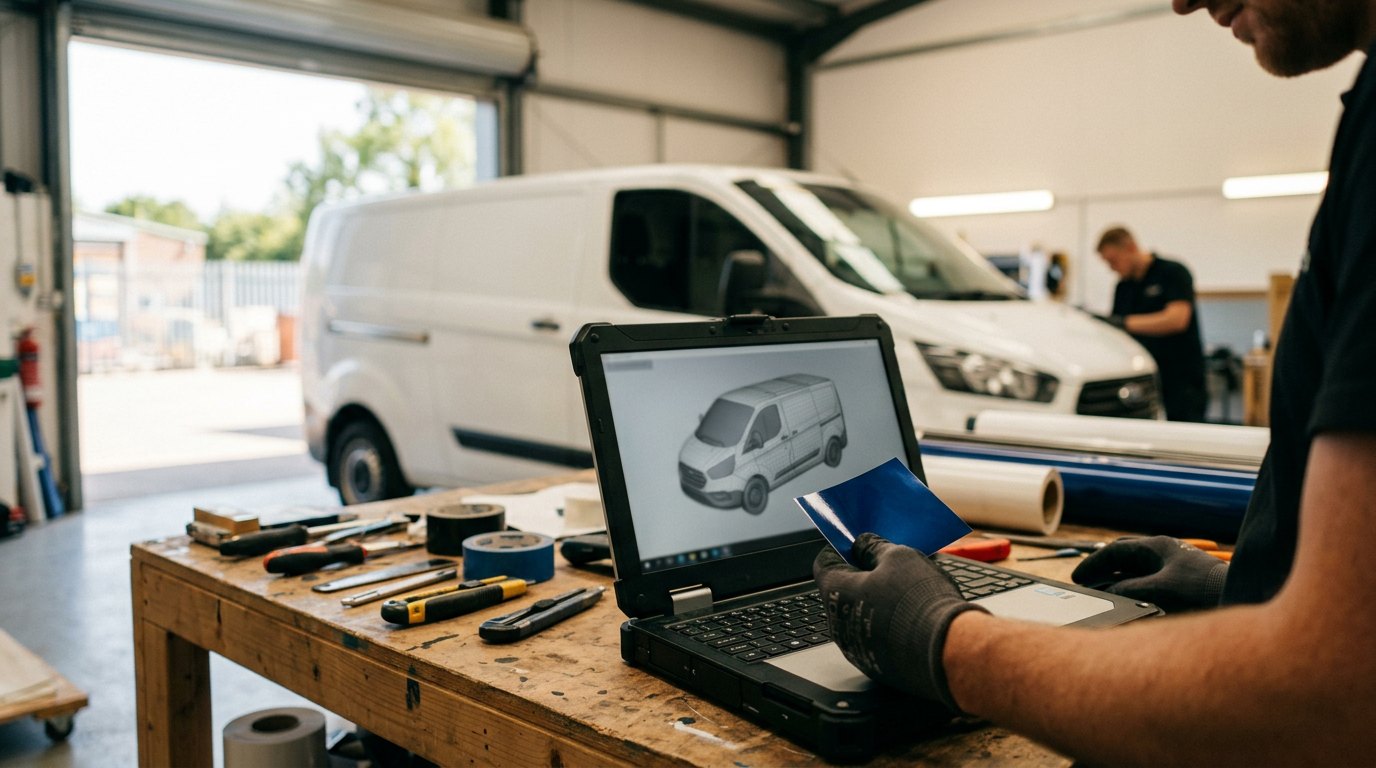
A fleet rollout succeeds or fails on preparation rather than fitting. The starting point is a master artwork designed for the real vehicle shapes in the fleet, with door handles, rubbing strips and panel seams taken into account so the key messages never fall on a broken surface. The principles of readable, scalable livery design are developed in this guide to vehicle wrap design.
Scheduling comes next. A wrap immobilises a van for one to three days, so operators stagger the programme: one or two vehicles at a time, ideally aligned with servicing windows or seasonal low activity, until the fleet is converted. Mixed fleets need template adaptation for each model, which argues for grouping identical vehicles in the same production batch.
Finally, the rollout should be measured. A dedicated phone number, a QR code or a specific landing page printed on the livery lets the business attribute enquiries to the vehicles, turning the wrap from a branding assumption into a measurable channel.
The topics covered here connect directly to the fleet personalisation work handled by Brands And Markets, whose services page describes the full range from lettering to complete livery programmes.
For a structured project, the online configurator provides a visual simulation and an initial costing in a few steps, which is a practical starting point before briefing a fitter for a multi-vehicle rollout.
A commercial vehicle wrap is one of the few marketing purchases that doubles as an asset protection measure: it brands the fleet, shields the paint and reverses cleanly at resale. The budget logic is favourable for any business whose vehicles circulate daily, with fitted prices from a few hundred pounds for lettering to several thousand for a full printed livery on a large vehicle.
The decision path is short. Define the coverage level the brand needs, confirm the material against the expected service life, check the V5C, plate and insurance points, and plan the rollout around vehicle availability. With those elements fixed, quotes from professional installers become directly comparable, and the project can move from intent to a scheduled programme in a matter of weeks.
Cut lettering and decals commonly start from a few hundred pounds per vehicle. A partial wrap on a medium van typically sits between 800 and 1,500 pounds fitted, a full wrap on a panel van between 2,000 and 3,500 pounds, and a printed livery on a large lorry or box body between 3,000 and 6,000 pounds. The final quote reflects surface area, film family, finish and labour rather than material cost alone. Fleet orders with repeated artwork usually bring the unit price down, because design, colour profiling and print setup are paid once and spread across the whole run of vehicles.
Only when the dominant colour of the vehicle changes. A full colour-change wrap must be recorded on the V5C registration certificate through the standard change-of-details procedure. Partial graphics, signwriting and lettering that leave the base colour unchanged do not require an update. Independently of registration, number plates, lights and reflectors must remain fully visible and unobstructed at all times, and the insurer should be informed of the wrap as a modification to keep the policy valid. A professional installer handles the technical constraints as standard practice.
Cast film applied by a trained fitter commonly lasts five to seven years in daily commercial use, while calendered film on flat panels is usually rated for one to three years outdoors. Duty cycle moves those figures in both directions: high motorway mileage, automatic brush washing and permanent outdoor parking shorten the service life, whereas hand washing and covered overnight parking extend it. Planning the removal before the adhesive ages keeps the operation clean and protects the paint underneath, which matters for resale and end-of-lease returns.
In the general case, yes. A wrap or signwriting applied to a commercial vehicle used for business purposes is treated as a business expense, and a VAT-registered business can normally recover the input tax under the usual conditions: the cost relates to business use and a valid VAT invoice is retained. The framework is set out in HMRC's guidance on motoring expenses and on reclaiming VAT on business purchases. Since individual circumstances vary, the treatment should be confirmed against current guidance or with the company's accountant before filing.
For fleet branding, film generally wins on flexibility. A wrap is reversible, protects the original paintwork, reproduces printed graphics that paint cannot deliver economically, and comes off cleanly when the vehicle is sold or returned at end of lease. A respray is permanent, requires longer downtime per vehicle and commits the fleet to one identity for the life of the paint. Paint keeps the advantage only where film struggles, such as heavily damaged bodywork that would need repair before wrapping anyway. Most commercial liveries are therefore produced in vinyl.
Prêt à transformer votre projet ? Discutons de vos besoins et de la manière dont nous pouvons collaborer.
Adresse : 28 rue Fresnel – F-78310 COIGNIERES
Téléphone : 01 85 40 01 75